
Turner County Deed Records by Instrument Type
The Turner County Clerk of Superior Court is the recorder for all real-estate instruments. It sits at 219 E College Avenue in Ashburn. The instrument type matters more than the label suggests. A deed proves a recorded transfer. But the document's terms decide what actually moved and on what conditions. Read the whole thing. Pay close attention to the legal description and any reservations.
| Deed Type | What It Does | Common Use |
|---|---|---|
| Warranty deed | Conveys the stated interest with warranties expressed in the instrument | Ordinary sale or transfer |
| Quitclaim deed | Conveys whatever interest the signer has without the same warranties | Interest release or title cleanup |
| Security deed | Secures a debt against real property | Financing, not an ordinary ownership transfer |
| Administrator or executor deed | Conveys property through authorized estate administration | Probate-related transfer |
| Tax deed | Records a conveyance arising from a tax process | Delinquent-tax research requiring careful follow-up |
Security deeds, assignments, liens, cancellations, and releases often sit beside warranty deeds in the index. They shape the record trail. None of them is a sale, though. Treating one as such can derail a chain. Confirm the party roles and the document text before drawing conclusions.
Turner County GSCCCA Deed Coverage
The county good-through page for GSCCCA real estate showed Turner coverage beginning January 1, 1989 and extending through September 1, 2026 when captured, with a four-day lag. The central name form displayed a January 1, 1990 start and an earlier through date. Use the county report and call the Clerk at (229) 567-2011 when the edge of coverage matters.
Turner liens were documented online from January 31, 2004 and plats from January 1, 2004. Older deeds, plats, and related volumes require the courthouse deed room or an archival route. A fresh filing may also reach the Clerk before the statewide index.
Search Fields for Turner County Deeds
The GSCCCA grantor-grantee form gives more control than a broad owner query. Search every relevant spelling. Check both party roles. Apply instrument filters only after a broad first pass, since a transfer can carry an unexpected label.
| Search control | Documented input | Practical use |
|---|---|---|
| Name | Last or business, first, middle | Find a person or entity |
| Party type | Grantor or grantee | Track who gave or received an interest |
| Instrument | Document-type selector | Separate conveyances, liens, and releases |
| Date | Beginning and ending dates | Focus the likely recording window |
| Display | Count and sort choices | Review a long chronology |
A solid result preserves the party name and role, the instrument type, execution and filing dates, book and page or instrument number, county, description or PT-61 reference, image access, and links to related documents when shown. Anything less invites a mistake.
Follow Turner County's Grantor-Grantee Chain
The newest deed names the current grantee and the grantor who conveyed the interest. That grantor's own earlier acquisition becomes the next link in the chain. Keep repeating the step. Match the same land description each time, not just the same surname. Otherwise, the trail will drift onto someone else's parcel.
- Find the current owner's acquisition with that owner listed as grantee.
- Open the image and record the grantor, legal description, date, and prior book-page citation.
- Search that grantor as a grantee in an earlier date range.
- Repeat while the tract description remains consistent, then switch to deed books when online coverage ends.
- Grantor
- The party giving the recorded interest.
- Grantee
- The party receiving the recorded interest.
- Chain of title
- The linked sequence of conveyances for the same land.
- Book and page
- The volume and page citation used to retrieve a filed instrument.
Turner County Plats, Easements, and Covenants
A deed's legal description may point to a recorded subdivision plat. It may also cite lot and block, right of way, utility easement, or restrictive covenant. Turner County's subdivision process separates preliminary review from the final plat that gets recorded. Revised phases and later easements can change the paper trail. They do this without conveying the whole fee interest.
Search the GSCCCA plat index within its documented online period. Then rely on the Clerk for older plat books. Compare every plat citation against the deed itself. A map image helps orient the tract. It does not overrule recorded calls or a survey.
Turner County Deeds Before County Formation
Turner County was created in 1905 from parts of Irwin, Wilcox, Worth, and Dooly counties. A chain reaching before that year may jump into a predecessor county's books. The land itself never moved. Identify the tract's old jurisdiction through descriptions, plats, and historical maps before searching those indexes.
The Georgia Archives county-records index is a practical guide to microfilm. The Archives tax collection pages can also help. Its research-help pages point toward older land, court, estate, and tax sources. Never bridge a gap from a name match alone.
Turner County Filing Alerts
The Filing Activity Notification System offers free alerts for name matches in participating clerk filings. Register personal and entity-name variants. Review any alert against the actual record. FANS does not produce a past deed chain, prevent a filing, or prove that suspicious activity occurred.
Note: An alert is a prompt to inspect a new filing, not proof that title changed.
Turner Estate Deeds and Court Orders
An estate transfer does not always look like a routine private sale. Turner County Probate Court handles administrations, wills, guardianships, and related matters. The Clerk records the administrator's, executor's, or other deed that affects the land record. Search the estate or representative name along with the decedent and the recipient.
A court order can affect title. The docket entry is only a lead, though. Read the operative order, its legal description, and any recording direction. Then confirm the resulting instrument in the deed index.
Get a Turner County Deed Copy
Start with an online image when GSCCCA access allows it. The statewide terms describe account and image charges. But the Clerk of Superior Court does not publish exact Turner County plain-copy, certified-copy, payment, mail, and turnaround rules online. For an authoritative answer, give the office the names, instrument date, county, book and page or instrument number. State whether you need certification.
The deed room at 219 E College Avenue is the in-person fallback. It is also the route for older volumes or filings outside the online span. A narrow written request can ask for an existing identified image. The office is not required to build a chain of title for the requester.
Recorded, not guaranteed. Turner County deed records show what reached the recording system. An index or image is not a title opinion, and unrecorded or misindexed interests may exist.
See the Turner County Grantor-Grantee Form
The official GSCCCA name-search form displays its county, party, instrument, and date controls for Turner deed searches.
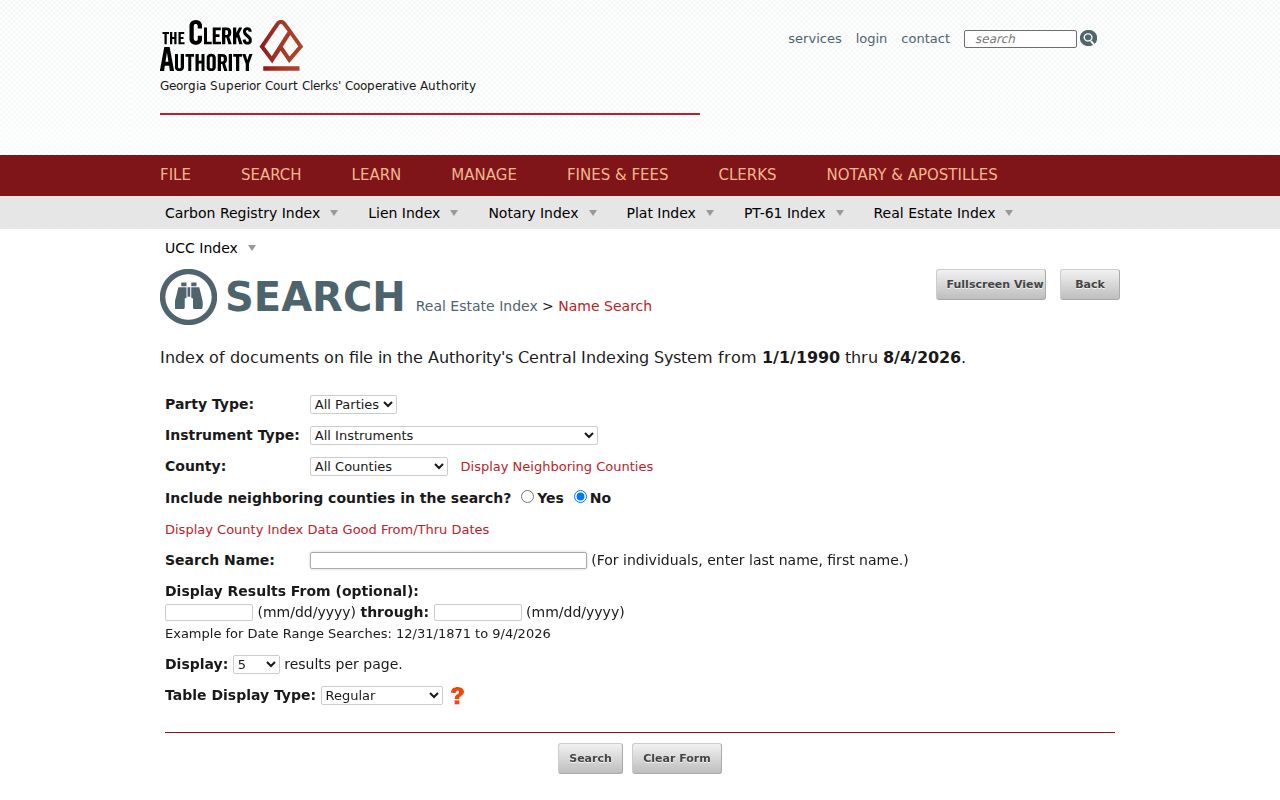
The form supports a focused Turner search. Even so, the index row must still be matched to the image and the legal description.
Reconcile Turner County Deeds with Other Files
An assessor's owner name can trail behind a new conveyance. A tax mailing address may reach a recipient far from the land. Lay those fields beside the most recent recorded grantee. Then weigh the filing date and the tract description. When a security deed shows up after the conveyance, read it as financing, not a second sale. Track any later assignments and cancellations on their own path.
Cross-references deserve the same skepticism. A deed that cites a plat calls for that plat. One that cites a prior book and page calls for the parent instrument. Where a conveyance follows probate or litigation, locate the court's authority. Pull any recorded order behind it as well. Each document should support the same parcel. A shared name alone proves nothing.
Request Missing Turner County Deed Records
Some records sit beyond online access and the public terminal. For those, send a narrow request to the Turner County Clerk. Give the party names, date range, document type, and any known book and page. State whether a plain or certified copy is needed. Ask the office to quote its current fee and delivery method. Copy charges and remote procedures are set locally.
Georgia open-records guidance does not oblige a custodian to build a title abstract. It also does not require research into a chain of title. So a request should target one identified deed, plat, release, or a defined book-page range. That narrow ask stands a far better chance of drawing a clear response and a useful estimate.
Build the final chronology in recording order. Keep execution dates too, since a document may be signed long before it is filed. Note corrections and re-recorded instruments rather than silently swapping out the first entry. A release may point to a security deed. Link the two records. Treat neither one as an ownership transfer.
Names need the same care. Search initials, full names, former spellings, estate styles, trust names, and business suffixes. Never accept a name as the only match. The county and legal description must match. So must the acreage or lot-block reference, prior citation, and parties. All must point back to the same Turner County land.
Pre-1905 work brings one more duty. Write a note explaining why the chain moves to a predecessor county. That prevents a later reader from mistaking a jurisdiction change for a break in ownership. It also preserves the evidence needed to return to Turner deed records after county formation.
Save the whole picture for every Turner County deed. Keep the index row and image together. So are book and page, party roles, filing date, and legal description. This compact record makes later review easier. It also exposes a missing link before anyone mistakes it for a completed chain.