
Identify Who Owns Turner County Land
The shortest sound route runs from place to person, then from person to the recorded grant. Turner QPublic is the county's official assessor link, though its information is described as a work in progress. Treat its owner line as a lead. It points you to the right parcel. The newest deed is the record that confirms who received title and how ownership was vested. The Turner QPublic landing page opens the assessor step.
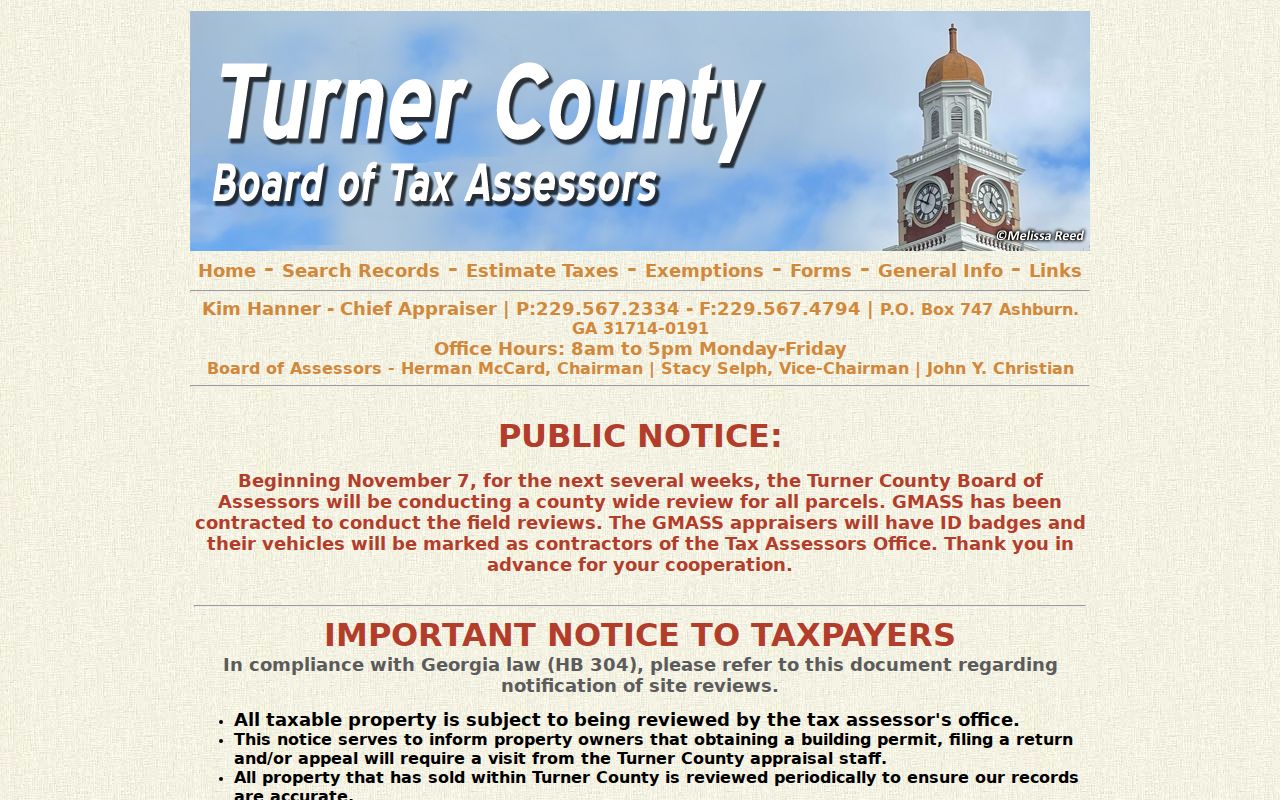
The official QPublic parcel card displays the current owner line. That name still needs confirmation against the newest deed before anyone relies on it.
- Search the street address through Turner QPublic. Save the parcel key, site address, owner name, mailing address, and legal-description summary.
- Search that owner as a grantee in the GSCCCA real-estate index. Use the date and instrument filters to locate the most recent conveyance.
- Read the deed image. Match the Turner County name, parcel description, prior deed reference, and recording date to the assessor card.
- If an entity appears as grantee, search its exact legal name with Georgia's Secretary of State. Use that record as an identity lead, not as proof that an officer owns the land.
Two independent county records answer the ownership question. When the latest filing falls inside an online lag, the Clerk's deed room supplies the freshest local check.
Turner County Property Owner Sources
Several public systems will show you a name. The labels are not equal, though. A tax mailing recipient, a GIS name, and the latest deed grantee can differ after a sale or an estate event, so keep the parcel number and legal description beside every name you note.
| Official source | Ownership clue | How to reach it |
|---|---|---|
| Tax Assessor | Assessor owner, site and mailing addresses, parcel key | QPublic or assessor office |
| Clerk of Superior Court | Latest grantee, deed type, recording date, book/page | GSCCCA or courthouse deed room |
| Georgia Secretary of State | Entity status, registered agent, and listed officers | Business Search |
| Probate Court | Estate representative and orders behind a later transfer | Probate record search or local office |
Turner QPublic separates assessment work from tax collection. The Tax Commissioner handles the bills and balances. A bill recipient is not the same as a deed grantee, so tax papers never replace the deed evidence. An owner search also will not reveal who occupies a house; occupancy and legal ownership are separate facts.
Trace the Turner County Grantee
The Clerk of Superior Court keeps Turner County deeds, real-estate instruments, liens, and plats. GSCCCA offers a name search filtered by party role, instrument type, county, name, and date range. Run the QPublic name as a grantee first. Then look for later conveyances under that same name.
A recorded deed carries the legal description. Compare subdivision and lot, acreage, metes-and-bounds calls, prior book and page, and any plat reference to keep a same-name hit from becoming a false match. The recording date sets the timeline. The signing date can come earlier.
Online coverage starts in 1989. Recent filings may lag briefly. For a brand-new deed, a pre-coverage instrument, or an image that will not open, call the Clerk at (229) 567-2011, visit 219 East College Avenue in Ashburn, or search the deed room in person.
Turner County Ownership Terms
The words around a property owner hint at which record you are reading. Read them with care first. Deciding who owns the land depends on knowing which document produced the name.
- Owner of record
- The name carried by an official roll or recorded instrument at a stated time.
- Vesting
- The deed language stating how title is held, including multiple grantees or a trust.
- Grantee
- The person or entity receiving the interest in a recorded deed.
- Situs address
- The physical property location, which may differ from the owner's mailing address.
- Legal description
- The land description based on a subdivision, lot, plat, acreage, or metes and bounds.
Names alone are weak proof. Two people may share a name, and an entity may have several near-identical versions, so the parcel and deed description turn a name into a property-specific finding.
Identify a Turner County Entity Owner
A deed may vest title in an LLC, corporation, trust, or estate rather than an individual. Search the exact entity text from the deed in the Georgia business registry using business name, control number, registered agent, officer, or designated agent. Starts-with, contains, and exact-match options are offered.
The registry resolves spelling and identity. It does not make a registered agent or officer the Turner County property owner. The entity named as grantee holds the deed until a later recorded instrument transfers the land.
A trust or estate deed may name a trustee, executor, or administrator. Their authority may sit in probate files. The administrator or executor deed records the actual transfer. Restricted probate or court material should not be bypassed.
Match Turner County Land Descriptions
A street address only locates land. It is not the legal identity. Turner County rural addresses may carry an Ashburn, Rebecca, or Sycamore mailing label outside the city boundary, and old deeds may describe a land lot, road, creek, or former county instead of a street number.
Copy the parcel number exactly from QPublic. Then match the deed's county, acreage, subdivision phase, lot and block, bearings, distances, easements, and prior deed reference. If the deed points to a plat, pull it. A GIS polygon helps with orientation but cannot replace this comparison.
The Turner County parcel maps section shows how the map, assessor key, plat, and deed fit together when boundaries are part of the owner question.
Respect Turner County Address Privacy
Some Turner County records lawfully hide a residence address. Eligible participants get a substitute address for public records through Georgia Safe at Home. The program also seals the address on voter rolls. VoteSafe protects a qualifying voter's residence information too. Neither program erases a deed or makes the land vanish from the property records. A substitute mailing address still leaves an owner of record. So work from the parcel number and the recorded ownership evidence instead of the address line. Avoid piecing together a protected residence from other sources or publishing what the programs shield. The Georgia Open Records Act also allows redaction when another law protects material. When a mixed file arrives partly withheld, ask the custodian for the segregable public portion. Also ask for the legal basis of any redaction.
Limits of a Turner County Owner Search
A Turner County owner search has clear limits. The recorded trail names the latest grantee. The assessor roll names the current owner of record. But it cannot prove who lives on the parcel. It cannot resolve an unrecorded claim, confirm that a debt was paid, or stand in for a title opinion. When the deed and the tax roll disagree, the explanation may be a correction deed, an estate matter, a court order, or simply a filing delay.
The sources themselves warn against over-reading. GSCCCA notes that its index is not the actual record. It also notes that older index data may have been recreated from images. QPublic describes its assessor data as a work in progress. Anyone relying on a Turner County property search should save the source URL, access date, parcel number, deed book and page, and the image used. The same trail can then be retraced later.
Lawful use. Turner County property owner records support land research and due diligence. Never use owner information to stalk, harass, threaten, or target a person.
When sources disagree, take the question to the right custodian. The Assessor handles parcel-card errors. The Clerk handles deed and index issues. Probate Court handles estate records. For stronger evidence of the present owner, the Turner County current owner workflow lays out the steps.
Request Turner County Owner Evidence
If QPublic does not answer the question, contact the Tax Assessor at 208 East College Avenue in Ashburn. You can also call (229) 567-2334. Ask for the existing parcel card tied to a stated address or parcel number. For deed proof, contact Clerk Mary L. Green at 219 East College Avenue, call (229) 567-2011, or use the courthouse deed room. The Clerk can confirm current copy fees and whether a remote-copy form exists.
Georgia's Open Records Act offers another route to a clearly defined existing record. A request should state the custodian. It should also give the address or parcel key, the document type, the date range, and a preferred electronic format. The agency generally has three business days to provide the record. It can state that none exists, or send a written estimate of time and lawful cost. It need not research who owns the parcel. It need not form a legal opinion or build a new title chain.
A deed image pulled from GSCCCA comes with its own access terms. The account information lists a regular account and a short single-use option. It also notes a per-page print charge. Prices should be verified at the time of access. For a fresh recording or an older instrument, the courthouse deed room remains the fallback. It also serves when an online image is missing.
Note: Keep every request tied to the land, not to broad facts about a person.