
How to Search Turner County Property Records
A Turner County property search works best when you lead with your strongest key. An address, an owner name, or a parcel number will open the first door. The Turner QPublic landing page is the county assessor's public entry point for all three. Field labels on the live form vary, so check them in a normal browser session. Write down the parcel number and owner from the card. Do not lean on the street address alone.
From there, widen the trail. The statewide GSCCCA real-estate index covers recorded instruments. The Tax Commissioner answers bill and balance questions. Map and plat sources add location context. Remember what each source is not: an assessor card is not proof of title. A map polygon is not a boundary survey.
- Search QPublic by address and save the parcel key, situs address, owner name, and assessed values shown.
- Search the GSCCCA name index for the latest grantee, then open the cited book and page when access permits.
- Ask the Turner County Tax Commissioner to confirm the current bill, payment, or delinquency status.
- Compare the legal description and recorded plat with regional or state map context.
- Request a copy from the actual custodian when an image, old volume, or current filing is not online.
Turner County Property Records Offices
Three offices split the core work of Turner County property records. The Clerk of Superior Court records deeds, liens, plats, easements, FiFas, and related instruments. The Board of Tax Assessors identifies and values taxable parcels. The Tax Commissioner bills and collects the tax. For visits, the assessor and collector share offices at 208 E College Avenue. The deed room sits in the courthouse complex at 219 E College Avenue in Ashburn.
Turner County Clerk of Superior Court
219 E College Ave
Ashburn, GA 31714
(229) 567-2011
Turner County Deed Index Dates and Search Fields
The GSCCCA real-estate name search takes a last or business name. It also accepts first and middle names, party type, county, instrument type, and a date range. Results sort easily. A single result can include the book and page. It can also show the filing date, instrument type, party role, and image status. Turner County's good-through report lists local real-estate coverage beginning January 1, 1989. The data runs a four-day transmission lag behind the Clerk's filings. The central search screen shows a slightly different statewide range. When the two disagree, let the county-specific good-through report and the Clerk control.
| Index field | How to use it | Turner County caution |
|---|---|---|
| Last or business name | Enter a person surname or full entity name | Try name variants and entity suffixes |
| Party type | Separate grantors from grantees | Search both directions for a chain |
| Instrument type | Narrow deeds, liens, easements, or releases | A security deed is not a title transfer |
| Date range | Focus on the likely transfer period | Older records need the deed room or archives |
The index itself is only a lead. A name alone is a weak match, so pair the book and page with the legal description to tie an instrument firmly to a parcel.
Turner County Values, Returns, and Appeals
The county assessor sets fair market value and the assessed value used for taxation. Turner County's official tax FAQ puts assessed value at 40 percent of fair market value. A taxpayer may file a return from January 1 through April 1. The return includes a proposed value. If the assessor adopts a different figure, the notice opens a 45-day appeal window. The Board of Equalization and arbitration are listed routes. A written appeal to Superior Court follows those routes.
Homestead rules deserve close attention. The exemption generally turns on owning and occupying the home on January 1. The filing deadline is April 1 for the current year. A move calls for a new application. Age-based and special exemptions carry their own rules. Confirm current eligibility with the Assessor rather than inferring it from a card.
Note: The assessor values property, while the Tax Commissioner answers bill, payment, and balance questions.
Turner County Maps Need a Source Check
The Southern Georgia Regional Commission map hub offers regional, flood, election, and boundary-review maps. A regional ArcGIS REST layer named OwnerParcels06042026 was last edited June 4, 2026. But it does not name its county explicitly. Treat it as unofficial until confirmed. It is not the official Turner County parcel viewer.
Map geometry still earns its keep. Use it to orient a search, spot nearby roads or waterways, and compare jurisdictional context. Legal boundary work belongs to the deed's legal description, a recorded plat, and a surveyor. Around Rebecca, Double Run Creek and the Alapaha River make water and flood references. These are worth checking closely.
Types of Turner County Property Records
Turner County property records form a trail, not a single file. A deed documents a conveyance. The assessment card supports valuation, and the tax account tracks collection. Plats and legal descriptions identify the land itself. Court, probate, and zoning files may explain a transfer or change the basic card never shows.
| Record Type | What It Documents | Kept By | Access |
|---|---|---|---|
| Deeds and easements | Transfers, parties, legal descriptions, rights | Clerk of Superior Court | GSCCCA index, courthouse deed room |
| Security deeds and liens | Recorded financing, claims, releases, FiFas | Clerk of Superior Court | GSCCCA real-estate and lien indexes |
| Assessment and tax | Fair market and assessed values, exemptions, bills | Assessor and Tax Commissioner | QPublic, office, county tax FAQ |
| Plats and parcel context | Lot, block, subdivision, geometry, map references | Clerk and mapping sources | Plat index, recorded books, regional maps |
| Permits and zoning | Applications, inspections, rezoning, subdivisions | Building & Zoning | Office request and county ordinances |
For ownership questions, start with Turner County deed records. For assessed value, exemptions, deadlines, or collection, turn to the property tax records guide. Permit and zoning files are another matter. The county publishes no city-specific permit database. Request those files from Building & Zoning at 208 E College Avenue.
Turner County Tax Bills and FiFa Records
The Tax Commissioner's office normally sets December 1 as the due date for real estate and business personal property. Mobile homes are normally due May 1. The official FAQ states that interest accrues at one percent per month after December 1 and describes a 10 percent penalty after 90 days, with a stated exception for certain homesteaded property under the listed liability threshold. The tax bill goes to the homeowner, not the mortgage company.
Nonpayment carries real consequences. More than 90 days of nonpayment can produce a tax FiFa recorded with the Clerk. Unpaid property may then be levied. The county publishes no online payment page or current tax-sale roster. Confirm any balance, payment option, FiFa status, or sale date directly with the Tax Commissioner and the Clerk.
Turner County Property Records Before 1905
Turner County was born in 1905, carved from Irwin, Wilcox, Worth, and Dooly. That origin matters for any chain of title. A family may show up in a predecessor county's deed book. The land itself never moved an inch. So figure out which county held the tract before 1905. Then work through that county's older grantor and grantee books before picking up the Turner volumes.
For archival digging, the Georgia Archives county-records microfilm index is the place to start. The Turner Clerk still holds whatever sits outside online coverage. Old place names help too. Shingler Heights, Ashburn Heights, and Hudson College Avenue can point toward plats or archival descriptions. They prove nothing about who owns the land today, though.
Note: Preserve every book, page, name spelling, date, and legal-description match when moving between predecessor counties.
Free Turner County Filing Alerts Through FANS
Georgia clerks file real estate records, liens, and plats every week. The GSCCCA's Filing Activity Notification System will email you. It emails when a participating clerk records something matching a name you register. FANS is free, and it looks forward only. It does not search old deed history. It does not block a filing, prove fraud, or replace reading the actual image.
Register every personal and entity-name variant you want watched. Then pull any notice itself through the Clerk and GSCCCA. Treat the alert as an early prompt to verify a filing. It is not a judgment on whether that filing is valid.
Building and Subdivision Files in Turner County
Turner County Building & Zoning handles permits, inspections, zoning and rezoning applications, and subdivision applications. Its office page links the zoning ordinance, the subdivision ordinance, and Municode. The county's iWorQ portal takes service requests and complaints. It is not a searchable permit database.
One clue sits inside the subdivision ordinance. The county has no water or sewer system of its own, and it names the public water systems for Ashburn, Sycamore, and Rebecca. For land near a city, ask about utility easements, subdivision conditions, site plans, final plats, and related agreements. A permit file can explain improvements, but it never replaces the deed or assessor record.
Turner County Digest Trends Need Parcel Context
The 2025 five-year history puts real and personal property at $406,872,038. The net digest sits at $297,246,100. Those are countywide totals. They say nothing about one tract. Official notices and an earlier GMASS revaluation contract show that digitization, field review, and assessment work can each refresh on its own schedule.
Write down the date attached to every parcel card, deed-index report, map layer, and digest you touch. A moving county digest never explains why your parcel changed. That answer lives in the parcel card. It also lives in the assessment notice, any exemptions, and the appeal record.
What Turner County Property Records Can and Cannot Tell You
Official Turner County property records answer many questions. They can identify the assessed owner and the latest recorded grantee. They also show taxable value, the parcel key, legal-description references, liens of record, and known plats. Estate transfers, court orders, exemptions, permits, and subdivision conditions may surface too. They cannot prove who occupies a site. They cannot guarantee an index is complete, establish a surveyed line, or offer a professional opinion on title.
Georgia's Safe at Home and VoteSafe programs can shield qualifying addresses. Other laws allow redaction or restriction. A masked address does not mean no interest exists. Ask the custodian for lawful confirmation, and respect protected information.
Use records with care. Turner County property records support due diligence, boundary research, estate work, and civic review. They are not a title opinion or survey, and owner data must never be used to stalk, harass, or harm anyone.
Turner County QPublic in View
The official Turner QPublic landing page is the assessor's entry point for parcel data.
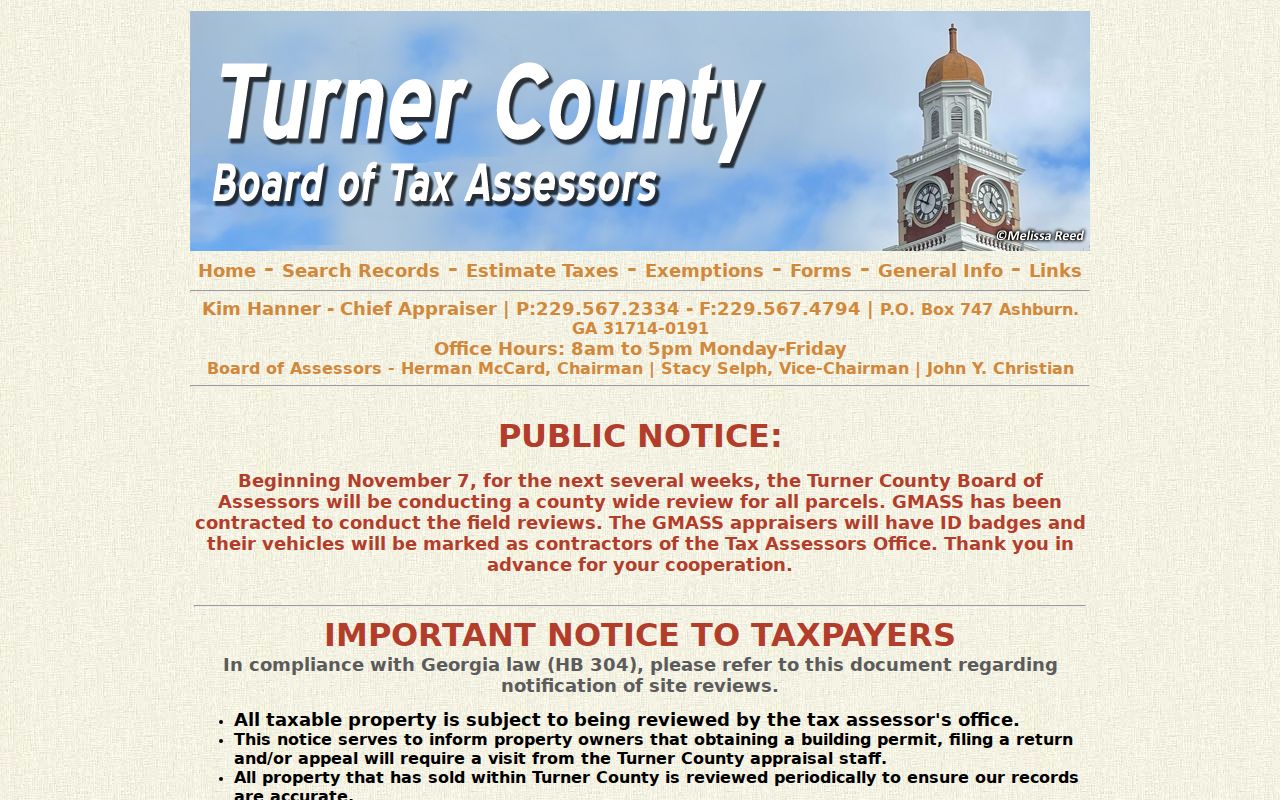
The page sends value questions to the assessor. Bill questions belong to the Tax Commissioner. That division is worth remembering before you call either office.
When the live search opens, record the parcel key, the owner listing, site and mailing addresses, the tax year, and every value label shown. The search page runs a browser challenge, so open it directly yourself. Read the interface live rather than assuming any field.
Turner County Open Records Requests
A stalled portal is not the end of the road. The office that keeps the record can still produce it. Georgia's Open Records Act covers documents, maps, photographs, and computer-based data. These are materials prepared, kept, or received by public agencies. State guidance generally calls for production or a statement that no record exists. Otherwise, a written time-and-cost estimate is due within three business days.
Ask for an existing record, not an answer to a broad research question. A strong request names the parcel, the address, the office, the record type, the date range, and your preferred electronic format. Request a parcel card or an assessment notice. You can also ask for a tax bill history, a named permit file, a zoning case, or a specific deed-book range. The agency may charge reasonable search, retrieval, redaction, and production costs. It uses the lowest-paid qualified worker and generally gives the first 15 minutes of search and retrieval free.
If material is withheld or redacted, ask for the legal basis. The county publishes no single request form or full fee schedule. So send your focused request straight to the right office. Choose the Tax Assessor, Tax Commissioner, Clerk, or Building & Zoning office that actually maintains the record.
A Turner County Record Verification Routine
Careful research leaves a trail. Note the portal URL, the date of access, the parcel number, the spelling of each party, the document type, the recording date, and the book and page. A legal-description clue helps too. Then set the newest recorded deed beside the assessor card and the office that owns whatever is in doubt. A value conflict goes to the assessor. A balance conflict goes to the Tax Commissioner. A boundary conflict calls for the deed, the plat, and often a survey. Matching the question to the right source saves hours of confusion.
Entities need extra care. When an estate, trust, or business shows up in Turner County property records, search the exact legal name rather than a shortened version. Probate Court can clarify an administrator's authority, and Georgia's business-entity search can identify the entity. Neither one replaces the recorded land instrument itself. Court dockets, tax notices, and GIS labels are useful leads, but keep their source date and limits attached to any conclusion you draw from them.
A simple research log holds everything together. Keep dated screenshots and saved citations in it. A screenshot shows what a portal displayed at a moment in time. A certified copy carries more weight, and it can support a formal transaction or a court need. The right level of proof depends on the use. Routine study may only need record citations and a quick confirmation from the office. A purchase, easement dispute, probate transfer, or boundary concern may call for professional review instead.
Scope matters just as much. Turner County property records work best when each office's role stays clear: the Clerk records instruments, the assessor values parcels, the Tax Commissioner collects the bills, and maps help you locate the land. Always check the record date before trusting a result. The county offices can confirm a newer filing, a corrected card, a paid balance, or a revised public file in minutes.