
Trace Turner County Former Owners
Work from the current conveyance backward, one row per transfer. The Clerk of Superior Court keeps the local land records. GSCCCA's online search handles modern name and book/page lookups, while the Clerk's deed room and the Georgia Archives reach earlier links in the chain.
| Transfer point | Grantor to grantee | Deed type | Book/page evidence |
|---|---|---|---|
| Newest recorded deed | Seller to present grantee | As indexed and shown on image | Current starting reference |
| Prior acquisition | Earlier seller to that grantor | Warranty, quitclaim, estate, or other deed | Prior deed cited in the newest instrument |
| Subdivision origin | Developer or parent owner to first lot grantee | Deed plus final plat | Plat and deed book/page |
| Pre-1905 tract | Parties in the county then governing the land | Historic deed | Predecessor-county volume and page |
Never plug a gap with a tax-roll name or a family story. Mark the gap instead. Then search both party roles, inspect corrections and estate deeds, and move on only when the legal description ties the same tract together.
Reconstruct Turner County Deeds Backward
The GSCCCA real-estate name search offers the grantor-and-grantee controls you need to walk a Turner County chain backward, deed by deed.
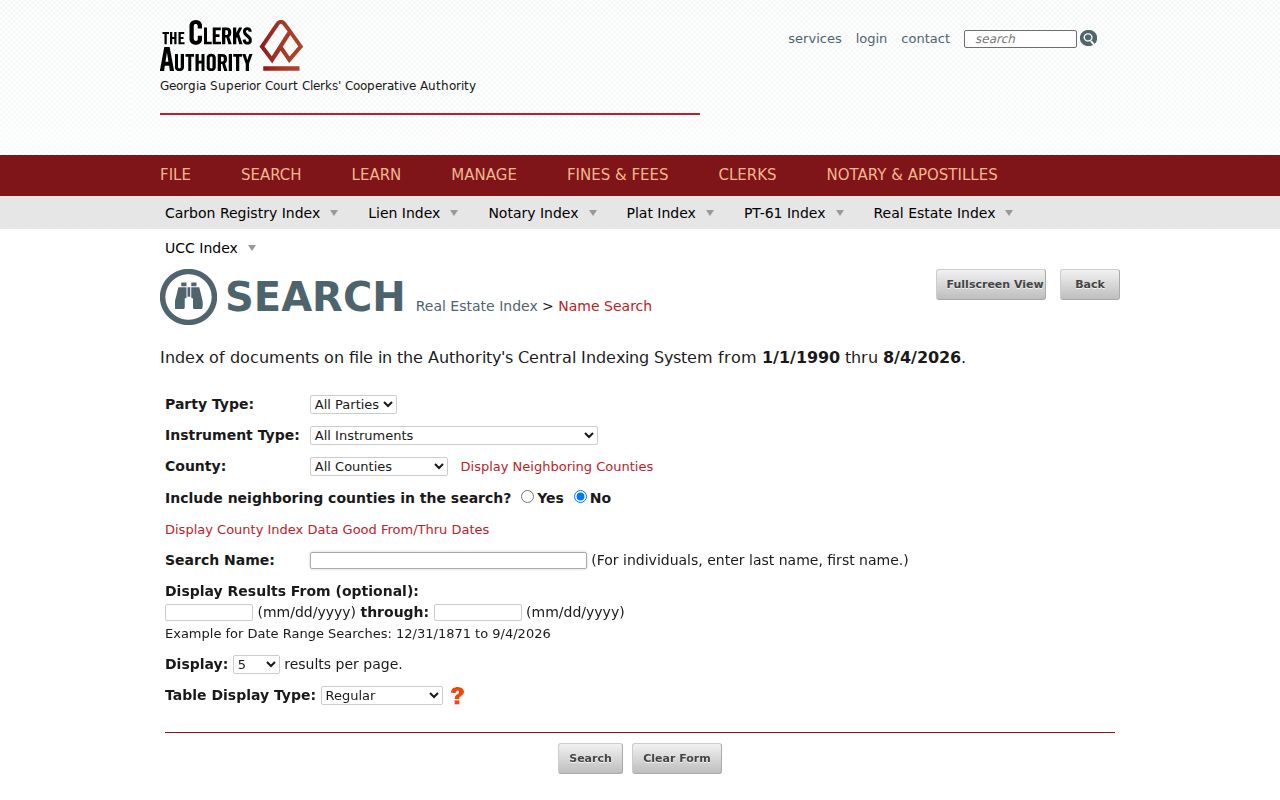
The form is only the doorway into the index. Every result still has to match the same legal description. Each one must be confirmed against the recorded image.
Flip the same name from grantor to grantee in the GSCCCA index. That role change is the engine of a reverse chain. Instrument dates give context, but sort the evidence by recording date and book/page.
- Find the current owner's acquisition deed with that owner shown as grantee. Verify the land description and record its book and page.
- Read the grantor from that deed. Search the same person or entity as grantee to find how that prior owner acquired the land.
- Repeat the role switch. Check name variants, correction deeds, estate instruments, and cited prior book/page references.
- When the chain reaches the online cutoff, continue through the Clerk's deed books, Archives index, and the correct predecessor county.
- Grantor
- The party conveying the stated property interest.
- Grantee
- The party receiving that interest.
- Chain of title
- The ordered sequence of recorded transfers tied to the same land.
- Reverse index
- An index organized to find conveyances through the grantor side of a name trail.
- Quitclaim and warranty deed
- Different conveyance forms whose legal effect must be read from the instrument.
Measure Turner County Online Depth
GSCCCA's Turner real-estate table lists a good-from date of January 1, 1989, while its central name display carries a 1990 system label. Treat those as two separate descriptions and confirm against the live search. Recent filings can also lag a few days behind in the index.
Online cutoff. The modern Turner deed index begins around 1989 to 1990. Older previous owners require deed books, microfilm, Archives leads, and Clerk help.
The online lien and plat series start later, in 2004. Those dates say nothing about whether older deeds, plats, or liens exist. They simply mark where the online series begins.
Use Turner Book and Page
A book and page reference is the spine of any older chain. GSCCCA provides a dedicated book/page search that asks for county, book, and page. The deed image may also cite a prior deed, plat, easement, or correction instrument.
Record the county every single time. A volume number without its jurisdiction is incomplete, especially near the county's creation date. Note whether your source is an index entry, an image, a transcript, or a certified record. Note this every single time.
Cross Turner County's 1905 Line
Turner County was created in 1905 from parts of Irwin, Wilcox, Worth, and Dooly counties. The land itself never moved. A nineteenth-century chain can therefore drop out of a Turner search. It can reappear in the deed books of whichever county held the tract at the time.
The official county history tells of Captain Jack Henderson. He lived in three counties without ever moving house. The story carries the records point: jurisdiction shifts around land, not the other way. Place the tract at each deed's date, then search that county's grantor-grantee books.
Extend Turner County Research Offline
The Georgia Archives County Records Microfilm Index offers holdings leads, and the Archives tax collection can point toward tax digests and deed-book material. Archives guidance notes that most local county records stay with the county, so the Turner Clerk remains the main fallback for post-creation books and recent gaps.
Ask for something defined: a volume, a page, a party, a date range, a plat. The Georgia Open Records Act does not oblige the office to build a title chain or answer a broad research question. A narrow request is easier to identify, price, and produce.
Follow Turner County Plat Revisions
A subdivision chain often starts with a parent tract. A final plat and later lot deeds follow it. Turner County's subdivision ordinance calls for a revised plat. It must identify the subdivision name, phase, date, and the prior book/page of record. Those references can bridge a parcel-number change.
Trace every split or combination through both the deed and the plat. A GIS polygon alone does not prove title was divided or merged. Easements, rights-of-way, and utility strips can also survive a lot transfer.
Recover Turner County Estate Transfers
Former owners can vanish from a plain sale sequence when death or estate administration intervenes. Turner Probate Court holds wills, administrations, and estate orders. Find the representative's authority first. Then return to the Clerk for the executor's, administrator's, or other recorded deed.
A probate name alone cannot insert an owner into the chain. The land description and the conveyance must tie the estate event to the same Turner County tract.
Know Turner County Chain Limits
The official county histories record no courthouse fire or wholesale loss of Turner deed volumes. That is not a guarantee that every volume or index is complete. Historical entries may have been recreated from images. The online database is not the record itself.
Keep a gap log listing the missing date span and party names tried. Add counties checked and book/page clues. The Turner County deed records page explains how to obtain a single instrument. Former-owner work stays fixed on the backward sequence.
Lawful use. Turner County former owner research supports house history, estate work, and land diligence. Never use it to track, stalk, or harass a living person.
A complete chain names its own weak points. Log every name variant, county, recording date, and source checked before declaring a prior transfer missing. Keep the result anchored to the land.
Carry the Chain Beyond Turner's 1905 Creation
Turner County was carved out in 1905 from Irwin, Wilcox, Worth, and Dooly territory. The same tract of ground stayed put. Its records, though, may sit in a predecessor county's books. A chain of title that reaches back to 1905 does not end at the Turner courthouse. So read the oldest Turner deed closely. Work out which earlier jurisdiction held the file.
What should you pull from that deed? The legal description points toward the right parent county. So do land-lot references, adjoining owners, water calls, and any prior book-page citation. Searching all four counties for a matching surname is a shortcut that leads nowhere. The Georgia Archives county-records microfilm index shows which county record series survive. It also shows which reels hold them. Its tax-digest collection adds dated ownership clues. A tax name can bridge a gap in the chain. It cannot replace the deed itself. For local volumes and cross-references outside GSCCCA's online range, the Turner Clerk's deed room remains the first stop.
Historic place names sharpen the hunt. Ashburn Heights and Hudson College Avenue surface in plats or archival files. So do the Shingler Heights Historic District, named creeks, and older road descriptions. Record the exact wording. Compare it with the tract description at each transfer. The goal stays fixed. Build a documented chain for the same land. Do not settle for a list of people who happened to share a place name.
Note every instrument type on each backward step, not just the parties. A security deed, cancellation, lien, easement, or corrective filing may name an owner without moving the ownership interest itself. Warranty, quitclaim, administrator, and executor deeds do the actual transferring, so keep the two categories clearly apart.