
Compare Turner County Property Value Types
Different sources answer different questions. The tax roll, the recorded deed, and private market evidence each measure something distinct in Turner County. The Board of Assessors sets the fair-market figure. The official FAQ is plain on this point. Assessed value equals 40 percent of fair-market value, and exemptions reduce the taxable base. A sale amount only describes a past transaction. The county tax FAQ is the local source for that relationship.
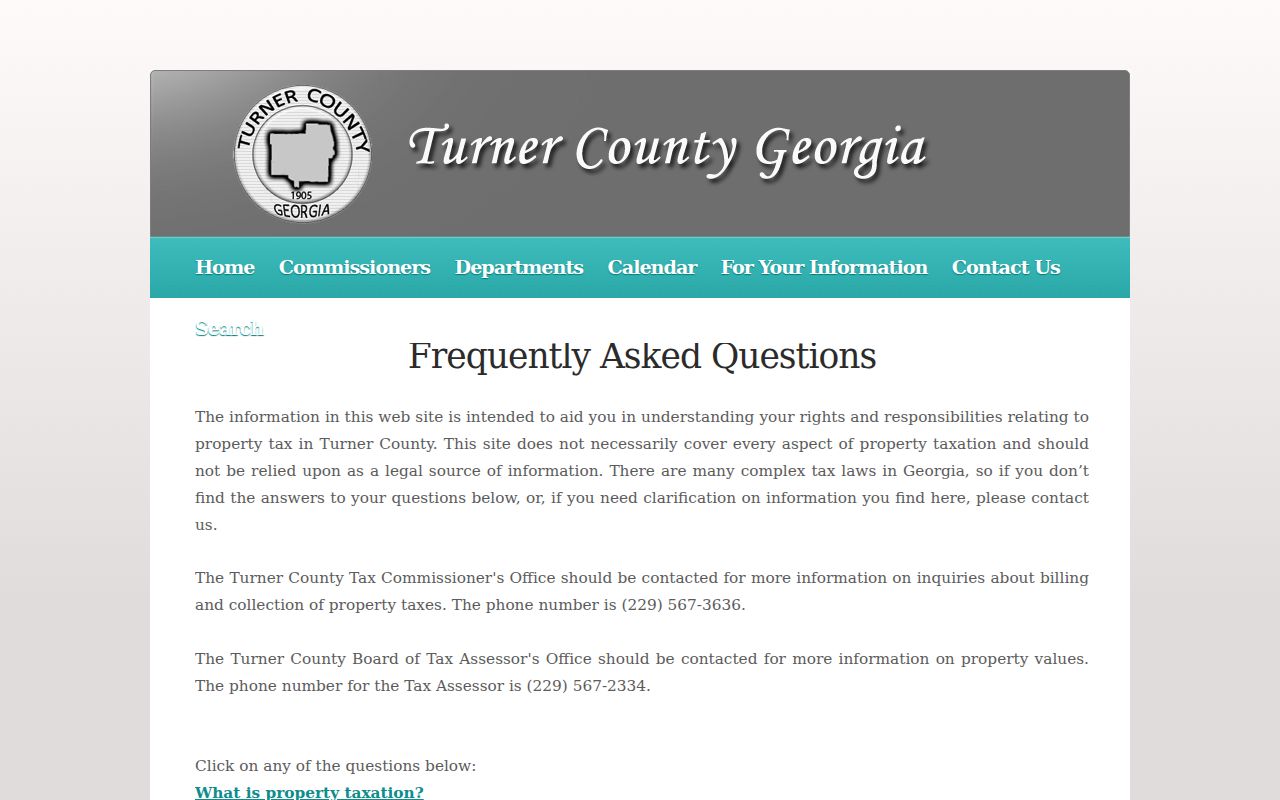
That Turner County page connects value labels to the local tax process. It is not an appraisal of any parcel.
| Value | What It Is | Where |
|---|---|---|
| Fair-market value | The assessor's full-value estimate for administration of the tax roll | Board of Tax Assessors and QPublic |
| Assessed value | Forty percent of the fair-market figure under the county's stated rule | Assessment record |
| Taxable value | Assessed value after applicable exemptions | Tax record |
| Last sale price | Historical consideration tied to a transfer, subject to record limits | Deed, PT-61 lead, or parcel card |
A Turner County assessed value is not a second sale price. It belongs to a statute and a tax year. A recorded consideration may reflect special terms or an older market. Label each figure when you copy it into notes.
Read the Turner County Assessment Formula
The tax FAQ lays out the sequence. The Board of Assessors sets fair-market value. Assessed value is 40 percent of that figure. Exemptions reduce the assessed base where they apply, and millage produces the final bill. Value fields end here; bills and appeals belong to the separate Turner County property tax guide.
Keep the fields separate. Fair-market, assessed, and taxable value are linked by the tax formula, but they are not interchangeable labels.
Hold the property and field constant across years. A taxable-value change can stem from assessment, exemption, or both. By itself, it says nothing about the market.
Capture Turner County Land and Improvement Values
The official Turner QPublic landing links Search Records, Estimate Taxes, exemptions, forms, and general information. The search endpoint requires an interactive browser session. Confirm the card labels in the portal itself.
| Card item to record | Why it matters |
|---|---|
| Tax year and review date | Fixes the number to a specific roll |
| Land and improvement components | Shows how the total is divided |
| Fair-market and assessed values | Supports the 40 percent comparison |
| Exemptions | Explains a lower taxable base |
| Sale history | Provides a dated transaction lead, not a present appraisal |
Save the disclaimer and source date too. QPublic describes assessment information as work in progress. When a displayed value is in question, the current office record controls.
Turner County Digest Trends Are Context, Not Comps
The 2025 five-year tax history notice tracks big movement. Real and personal property totaled $270,812,697 in 2020 and $406,872,038 in 2025. The net digest rose from $217,225,198 to $297,246,100 over the same span. Exemptions rose as well.
County totals like these show a changing roll. They cannot become a percentage estimate for one house, farm, or commercial parcel. New property, reclassification, exemptions, review work, and broad reassessment all shape the digest.
Note: Cite the notice year when using digest figures. Never apply a county-wide shift to one parcel.
Look Up a Turner County Property Value
Start with the official assessor route. Preserve enough context to reproduce the result. If the live search blocks access, call the Chief Appraiser's office at (229) 567-2334 for the existing card rather than substituting an unverified commercial estimate.
- Search Turner QPublic by the full site address, then try the exact parcel key if address variants fail.
- Record the fair-market, assessed, and taxable figures with their tax year and update date.
- Separate the land and improvement components and note each exemption shown.
- Check the latest deed through GSCCCA for a dated sale or consideration reference.
- Assessed value
- The statutory fraction of the assessor's fair-market figure, stated locally as 40 percent.
- Fair-market value
- The Board of Assessors' full-value estimate for the roll.
- Assessment level
- The ratio linking assessed and fair-market value.
- Consideration
- A transfer amount or value reference that may appear with a deed; it is historical transaction data.
A Sale Price Needs a Recorded-Date Check
The GSCCCA real-estate index traces grantors and grantees. Book and page search retrieves a known instrument. Turner's good-from display currently begins January 1, 1989, and new filings can lag transmission by several days.
A deed or PT-61 lead may preserve consideration. GSCCCA warns that index data can change, and PT-61 is not the official filing. Confirm the instrument, transaction type, parties, and date. A family transfer, correction, or other nonstandard conveyance may not resemble an open-market sale.
Review History Can Put Turner Sources Out of Step
A 2022 county agenda approved Clerk-record digitization and a GMASS revaluation contract. Later notices described parcel field review. Digest totals shifted sharply in 2024 and 2025. Together the records suggest deed images, parcel cards, and spatial layers may carry different refresh dates. That is a source-control issue, not a wrong value. Note when you checked each system. If QPublic, a notice, and a deed disagree, ask the Assessor which roll year controls the assessment and use the Clerk for the recorded transaction.
Exemptions Change Turner County Taxable Value
Homestead treatment explains many gaps between taxable and assessed value. The county FAQ sets the ground rules. An owner must occupy the home on January 1. Filing by April 1 applies to the current year. A move requires a new application. Age-based programs, freeport, and other special exemptions carry their own current rules. Confirm eligibility with the county rather than inferring it from a card.
When comparing two parcels, never treat an exemption difference as a market-value difference. Put fair-market value, assessed value, each exemption, and taxable value on separate lines. Exemptions can vanish after a purchase. Ask which tax year and filing status the card reflects.
Turner County Value Records Have Offline Channels
The web portal is not the only way in. The Chief Appraiser takes calls at (229) 567-2334, and a caller can ask for a parcel card by parcel number or walk the office route at 208 E College Avenue. A requester may also file a narrow Georgia Open Records Act request for one named card or assessment notice, with an itemized estimate attached.
For the transfer side of the comparison, the Clerk at 219 E College Avenue holds the recorded deeds. GSCCCA online covers much of it. For very recent filings, older books, or an image the web system will not show, go straight to the Clerk. Keep two columns clear: the Assessor's tax-purpose value on one side, the Clerk's transaction evidence on the other.
Limits of a Turner County Property Value
Every parcel value in Turner County comes from a mass-appraisal process. That process is built for the tax roll. The resulting number can lag a fast-moving market. It can also miss a recent condition change, or diverge from the actual terms of a specific sale. A parcel card has other gaps too. It does not establish title, fix exact boundaries, or price the cost of repairs.
Value versus price. A Turner County assessed value is for taxation and does not predict what the property will sell for. Use a licensed appraisal for a current market opinion.
Purchase diligence needs more than the tax card. Set the parcel card beside the recorded deed. Also weigh the property's current condition and a qualified appraisal. Keep each source's date and purpose visible. Avoid merging the numbers into one unsupported estimate. If a structure changed after the last field review, ask the Assessor. Confirm which characteristics and tax year the current parcel card reflects.
A sound comparison also records the source date. A 2025 digest total, a 2026 map edit, and a current parcel card each describe a different snapshot. When estimating Turner County property value, never substitute one for another without noticing the gap.